Breast reconstruction in Poland is becoming increasingly popular among European patients. The country stands out for its modern healthcare facilities, the expertise of its specialized surgeons, and rates that are often much more attractive than those in France or other Western European countries.
Choosing Poland for this procedure allows you to benefit from an excellent quality-price ratio, while having access to some of the newest and safest surgical techniques available.
| Reconstruction method | Average price in Poland |
|---|---|
| Traditional breast implant | €2,500 – €4,000 |
| DIEP flap (abdominal tissue transfer) | €5,000 – €7,000 |
| LD flap (latissimus dorsi) | €4,000 – €6,000 |
| Reconstruction by lipofilling (autologous fat) | €2,800 – €4,500 |
Prices updated for 2025, they usually include hospitalization fees but may vary according to the clinic and case complexity.
Poland has modern plastic surgery centers, regularly inspected by strict health authorities. Professionals are often internationally trained and apply European safety standards. Polish clinics focus on quality of care and prevention of infection risks.
You do not need to speak Polish for your procedure. In the vast majority of clinics, the medical staff speaks English, and some locations offer coordinators who speak French to facilitate your stay and file management.
For French and EU citizens, no visa is required to travel to Poland. A valid ID card or passport is sufficient. Remember to also bring your European Health Insurance Card.
Poland is easily accessible from France, with many daily direct flights from Paris, Lyon, Marseille, or Nice to Warsaw, Krakow, or Gdansk. Flight prices are competitive, and the journey usually takes only two to three hours, facilitating planning and reducing pre- and post-operative fatigue.

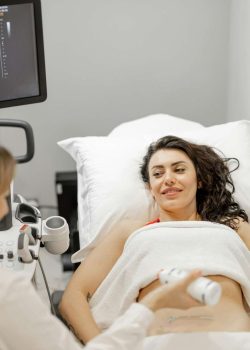





The duration of the stay in Poland for breast reconstruction varies depending on the surgical technique used and postoperative recovery. In general, it is recommended to plan for a stay of 7 to 14 days: 2 to 3 days for immediate hospitalization, followed by several days of postoperative monitoring in the clinic or nearby accommodation.
For DIEP or LD flap reconstructions, the stay tends to be longer (up to two weeks) due to the complexity of the procedure and the need for increased monitoring. It is wise to allow some flexibility in case additional check-ups are required.
Many Polish clinics specializing in reconstructive surgery offer tailored logistical support. Airport–clinic–accommodation transfers can be organized, often included in the surgery fees or available as an option.
A translation service is usually available, especially for French-speaking patients: this is often a coordinator who will accompany you throughout the process, from consultations to post-operative follow-up. Splints, dressings, and initial medications are, depending on the clinic, provided upon leaving the operating room. Do not forget to check insurance matters: specific travel health coverage or an extension to your private insurance is highly recommended in case of unforeseen medical issues.
Pre-packaged formulas may be available, combining surgery, accommodation, transfers, and sometimes even meals. These packages are reassuring due to their user-friendliness and simplicity: they minimize remote administrative tasks.
However, always check precisely what is included (number of nights, transportation, postoperative consultations, etc.). Some elements – additional tests, medications beyond the stay, dressing changes once back in France – may remain at your expense.
You can enjoy a short period of sightseeing in Poland, provided you proceed with caution. Before the procedure, a few days of light tourism may be feasible. After breast reconstruction, the convalescence period usually requires rest; any cultural visit or physical activity should be authorized by your surgeon.
In most cases, it is advised to keep activities to short walks or discovering local heritage without exertion, avoiding long walks, stairs, or tiring transport (especially during the first few days following surgery).
Post-operative follow-up is an essential phase after breast reconstruction in Poland. It plays a key role not only in monitoring healing and preventing complications but also in ensuring the aesthetic result and long-term wellbeing. Diligent monitoring allows personalized care for each patient’s needs and rapid intervention if problems arise.
Many patients wonder whether it is possible to continue follow-up care in France after an operation in Poland. The answer is generally yes: Polish surgeons provide their patients with a complete medical file (surgery reports, care instructions, progress reports). These documents are essential for informing a French practitioner, who can then take over the post-operative monitoring (scar check-ups, implant surveillance, nursing care).
It is important to anticipate your return and to book an appointment with a healthcare professional in France from the outset. This local follow-up will reduce the risks related to difficult travel or distance from the original clinic when problems occur. Some patients also choose to return to Poland for a medium-term check-up if it is necessary according to the surgical technique used.